The Constant Variable: Oil, Sovereignty, and 500 Years of Extraction in Venezuela
Someone in the comments of a recent LinkedIn post told me I was “venezuelasplaining.”
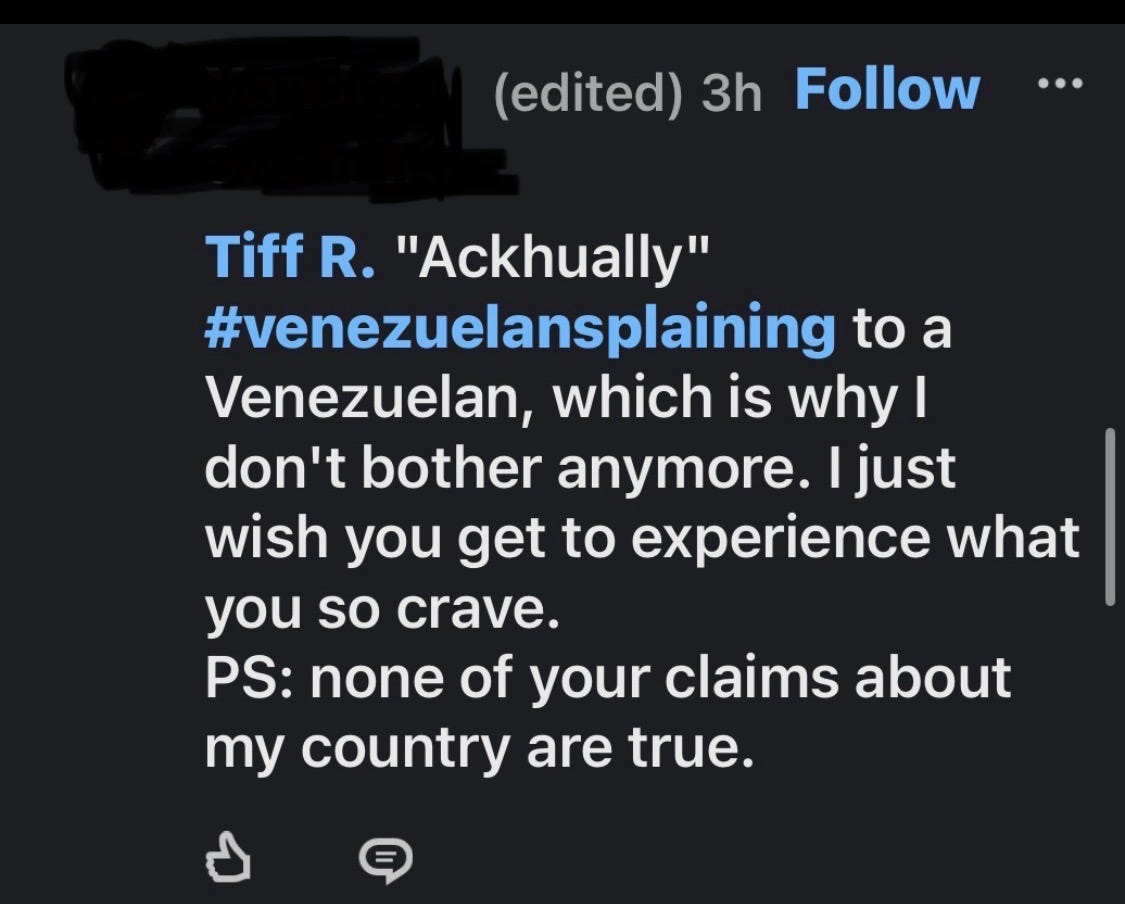
The charge was that I’d claimed Venezuela has never actually been a democratic socialist or communist state, and that US intervention bears significant structural responsibility for the conditions that produced Maduro. Both of those claims, apparently, were too much.
So. Let’s do this properly.
What follows is not a defence of Chavismo, Maduro, or authoritarian consolidation in any form. It is a documented account of what the United States government, its affiliated institutions, and the international financial bodies it has historically dominated have done in Venezuela since 1948. And why the labels “communist” and “democratic socialist,” as applied to Venezuela, tell us more about the needs of US foreign policy messaging than about Venezuelan political economy.
I. The Label Problem
Venezuela is not, and has never been, a communist country. This is not a contested claim.
Venezuela’s government identified its ideology as “Bolivarian Socialism” or “21st Century Socialism.” Its constitution explicitly protects private property rights. While the country nationalised major industries and implemented sweeping social programmes, it never abolished private enterprise, never operated under a single-party communist system, and never pursued the stateless, classless society that communism envisions.
Between 1999 and 2011, Venezuela’s Gini coefficient fell from 0.5 to 0.397, the lowest in Latin America at the time, according to the UN Economic Commission for Latin America and the Caribbean (ECLAC), and comparable to the United States in that period. That is not a description of Soviet collapse. That is a description of a redistributive welfare state operating on oil revenues, closer to Norway in the 2000s than to Cuba at any point.
The “communist” framing serves a specific purpose: it collapses distinctions that matter, renders any resource nationalism illegitimate, and provides retroactive justification for interventions that were underway before Chávez had been in office long enough to implement anything.
## II. The Extraction Economy Never Ended. The Flag Changed.
Venezuela’s relationship with external powers extracting its resources and managing its sovereignty did not begin in 1948. It did not begin with oil. It began in 1499, when Spanish colonisers arrived on the northern coast, encountered the Timoto-Cuica, Carib, and Arawak peoples, and began the process of converting a functioning society into a supply chain.
The colonial economy ran on a straightforward logic: identify the commodity with external market value, organise indigenous and then enslaved African labour to produce it, and export the surplus to enrich distant capitals. In the 16th and 17th centuries that commodity was gold, pearls, and livestock. By the 18th century it was cacao, which became Venezuela’s dominant export, monopolised by the Royal Guipuzcoan Company of Caracas, a Basque trading firm chartered by the Spanish Crown in 1728. The encomienda system assigned indigenous people as bound labour to Spanish landholders. When indigenous populations were decimated by disease and violence, enslaved Africans replaced them in the coastal plantation economy. The social hierarchy that emerged, Spanish-born peninsulares at the top, Creole elites below them, mixed-race populations further down, enslaved people at the base, was a hierarchy organised around extraction and enforced through racial stratification.
Independence in 1821 changed the flag. It did not change the structure.
The Creole elite who led the independence movement, the Mantuanos, were the landowning class. Their grievance with Spain was not that the extraction economy was wrong. It was that they were not the primary beneficiaries of it. The 1830 constitution they enacted after Venezuela separated from Gran Colombia reflected this plainly: property qualifications for voting, guarantees for freedom of trade and commerce, and the continuation of slavery. The commodity export economy continued. Foreign creditors, primarily British, moved in where Spanish commercial monopolies had been. By the end of the 19th century Venezuela was enmeshed in foreign debt and recurring fiscal crises, with European gunboats arriving at its ports to collect.
That last sentence is not a metaphor. In 1902, British, German, and Italian warships physically blockaded Venezuela’s coastline and bombarded one of its ports when Caracas defaulted on foreign debts. The incident alarmed US President Theodore Roosevelt, not because European gunboat diplomacy against a sovereign nation was objectionable, but because it demonstrated European military presence in what the US considered its sphere.
His response was the Roosevelt Corollary to the Monroe Doctrine, issued in December 1904. Where the Monroe Doctrine of 1823 had warned European powers to stay out of the Americas, the Roosevelt Corollary asserted something categorically different: that the United States had the right and the obligation to intervene in any Latin American country exhibiting what Roosevelt called “chronic wrongdoing,” a category that explicitly included unpaid foreign debts and civil unrest. Historian Walter LaFeber summarised it precisely: Roosevelt “essentially turns the Monroe Doctrine on its head and says the Europeans should stay out, but the United States has the right, under the doctrine, to go in to exercise police power to keep the Europeans out of the way.”
One colonial hegemon replaced by another, with a doctrine framed as its opposite.
The two decades following the Corollary saw direct US military intervention in eight countries: Cuba, the Dominican Republic, Guatemala, Haiti, Honduras, Mexico, Nicaragua, and Panama. Venezuela was not on that list only because its dictator at the time, Juan Vicente Gómez, who ruled from 1908 to 1935, had made himself maximally useful to American and British oil interests after commercial oil production began in 1914. He granted generous concessions to Standard Oil, Shell, and Gulf. In exchange, his regime received tacit external support and faced no intervention. The extraction economy had simply updated its commodity from cacao to petroleum and its patron from Spain to the United States.
By the time Venezuela held its first genuinely free election in December 1947, the country had spent over four centuries as an extraction economy managed by successive external patrons. Spain. British creditors. US oil companies. The specific actors changed every few generations. The structural logic: extract the resource, manage the political conditions that enable extraction, suppress any government that attempts to redirect the surplus toward its own population. It did not change.
That is the context in which 1948 needs to be read.
III. 1948: The Original Template in Practice
The pattern does not begin with Chávez. It begins with oil.
In December 1947, Venezuela held its first genuinely free and democratic election under universal suffrage. The novelist Rómulo Gallegos won with 74.3% of the vote, still the largest presidential margin in Venezuela’s modern history. He took office on 15 February 1948. His government passed what became known as the “fifty-fifty” law: foreign oil companies, Standard Oil, Gulf, Shell, would be required to split profits equally with the Venezuelan state. Democratic Action launched a programme of reform that included the profit-sharing tax decree, encouragement of labour unions, and support for health, housing, education, and agricultural development. These reforms provoked strong opposition from conservative forces.
Nine months after taking office, Gallegos was removed in a military coup.
The exiled President Gallegos accused United States oil companies and local Venezuelan capitalists of instigating the army clique. The oil corporations, holding approximately two billion dollars of investments in Venezuela, were angered by the 50% profits tax. Gallegos implied that the US State Department was not without knowledge of the conspiracy; the military attaché of a “large power” was at army headquarters when the coup was staged.
Whether the US Embassy directly coordinated the coup remains disputed. No declassified documents for 1948 confirm it the way 2002 is documented. What is on record: the Truman administration recognised the coup government rapidly and without public objection, and US oil company investment in Venezuela was preserved intact. A decade of military dictatorship followed. The fifty-fifty law was gutted. The oil concessions remained.
This is the template. A democratically elected government attempts to assert resource sovereignty. External actors with financial interests in the status quo facilitate its removal. The language of stability and anticommunism provides cover.
IV. The Cold War Decades: Infrastructure for Control
The decades between 1948 and the 1980s were a sustained project of political shaping.
During the Cold War, US public diplomacy prioritised educational programmes targeting Venezuela’s military and youth specifically to contain communism and promote anti-communist political development. By the 1990s, that had evolved into shaping the development of political party structures, training civil society leaders, and establishing NGOs to influence elections.
This is the apparatus that the National Endowment for Democracy (NED) and USAID would later formalise. The mechanisms were already in place. The Cold War provided the ideological scaffolding; the infrastructure was built over decades. Training military officers, funding party organisations, cultivating a generation of politicians whose formation was explicitly oriented toward Washington’s strategic interests: none of that begins in 2001.
Across the broader region: in the 1970s, the CIA attempted to thwart Allende’s ascent in Chile and later lent support to General Augusto Pinochet, whose regime, according to Chile’s National Commission on Political Imprisonment and Torture (the Valech Commission), murdered 3,065 citizens and committed human rights abuses against almost 40,000. In the 1980s in Nicaragua, the US backed right-wing Contra rebels against the socialist Sandinista government. Venezuela watched all of this. It was not an abstraction.
V. 1989: The Caracazo and the Washington Consensus
The event that made Chávez’s rise politically possible was not engineered by Chávez. It was engineered by the IMF, with the enthusiastic backing of the United States government.
Carlos Andrés Pérez was elected president in 1989 on an explicit campaign promise to oppose IMF-style economic liberalisation. He had called IMF structural adjustment programmes “a neutron bomb that killed people but left buildings standing.”
Two weeks after taking office, Pérez accepted a $4.5 billion IMF loan and immediately imposed shock therapy without anaesthetic: trade liberalisation, abolition of exchange controls, massive privatisation of state enterprises, drastic cuts in social programmes, and increases in the prices of essential goods and services.
Prices for oil, electricity, telecommunications, and water increased 100% in a short period. A decree authorising a 30% overnight increase in public transport fares was the immediate trigger. The poorest Venezuelans took to the streets. Security forces massacred them. Official Venezuelan government figures placed the death toll at 277; independent human rights organisations estimated the number killed exceeded 1,000, with some estimates reaching as high as 3,000. The true figure remains contested, in part because many victims were buried in unmarked mass graves.
While the massacre was still underway, US President George H.W. Bush called Pérez to commiserate and offer loans. The New York Times ran a profile shortly after describing Pérez as “a charismatic social democrat,” with no mention of the massacre. The article focused instead on Bush’s gratitude that Venezuela was boosting oil output to protect the US economy following the Iraqi invasion of Kuwait.
The Caracazo is the political origin point of Chavismo. Not ideology. Not Cuban influence. The massacre of poor people by a government implementing Washington Consensus shock therapy, and a US administration that called to offer loans to the man who ordered it.
VI. 2001–2004: The Coup, the Cash, and the Cover
Chávez won the 1998 election with over 56% of the popular vote. His 1999 constitution was ratified by referendum. He was re-elected in 2000. In September 2012, former US President Jimmy Carter, speaking at a Carter Center event in Atlanta about the 92 elections the organisation had monitored, said of Venezuela’s automated voting infrastructure: “I would say the election process in Venezuela is the best in the world.” Carter was specifically praising the technological auditability of the system; the Carter Center had observed Venezuela’s elections since 1998 without finding evidence of vote manipulation that altered outcomes.
None of this deterred Washington.
Between November 2001 and April 2002, the NED, the State Department, and the Department of Defense provided training, institution building, and other support totalling approximately $3.3 million to Venezuelan organisations and individuals, some of whom were directly involved in the coup events of April 12–14. NED funding alone in that six-month period exceeded $2 million, up from $200,000 the prior year.
CIA documents showed the US government had advance knowledge of the coup that briefly overthrew Venezuela’s democratic government. The Bush Administration not only failed to warn Venezuela, but actively pretended it was not a coup at all. The US Ambassador had breakfast at the presidential palace with the installed coup leader on his first day in power.
The coup failed. Chávez was restored. And then:
The NED and USAID channelled multi-million dollar funding to opposition leaders Leopoldo López and María Corina Machado, including their political parties and NGOs. These agencies filtered more than $14 million to opposition groups between 2013 and 2014 alone, including funding for political campaigns and anti-government protests. This continued a pattern of financing to anti-Chávez groups that began in 2001.
“Democracy promotion” as a funding category for organisations that had been involved in an attempted coup against a democratically elected government is a particular kind of audacity.
VII. 2017–2024: Sanctions as Collective Punishment
The Obama administration declared Venezuela an “extraordinary threat to national security” in 2015. A country that had never started a war in its history.
The Trump administration’s first term escalated to sectoral sanctions. The strongest measures came in 2019: sanctions on Venezuela’s state-run oil company PDVSA effectively prevented it from selling petroleum to the United States, Venezuela’s biggest customer at market prices. The country depends on oil for 90% of its export income. Cutting off that market did not remove Maduro. It collapsed public services and pushed nearly 8 million people into exile.
The Biden administration attempted a more calibrated approach. In October 2023, after Maduro and the opposition signed an agreement including elections, OFAC issued licences authorising transactions in Venezuela’s oil and gas sector for six months. In January 2024, after Venezuela’s supreme court upheld a ban on opposition candidate María Corina Machado, OFAC revoked one licence. In April 2024, the administration announced it would not renew the oil sector licence. Carrot, stick, and ultimately neither outcome: the 2024 election was stolen regardless.
VIII. January 3, 2026: The Pretence Drops
On 3 January 2026, the US launched a unilateral military operation in Venezuela that resulted in the capture of Nicolás Maduro, followed by President Trump’s announcement that the United States would “run” Venezuela, including control of its oil sales.
At the first press conference following Maduro’s capture, Trump dismissed María Corina Machado, Nobel Peace Prize laureate and leader of Venezuela’s democratic opposition, stating explicitly that she “does not have the support or respect” needed to govern. He simultaneously signalled willingness to reach an understanding with the regime’s existing apparatus insofar as it aligned with US strategic interests, beginning with control of oil resources.
The US put efforts into working with the current regime to get priority access for American companies to Venezuela’s oil markets, while sidelining Machado and endorsing Rodríguez, who was part of the Maduro apparatus.
The objective was never the restoration of Venezuelan democratic governance. The democratic opposition was sidelined the moment a deal on oil access became available. The rhetoric of democracy was the vehicle. Oil was the destination.
IX. What Venezuela Actually Was
Venezuela under Chávez was a petrostate running redistributive social programmes on oil revenues, with significant democratic deficits that worsened over time and became fully authoritarian under Maduro. It was not communist. It was not a workers’ state. Its constitution explicitly protected private property rights, and it never abolished private enterprise.
What it did do was assert that Venezuelan oil revenues belonged primarily to Venezuelans. That assertion, the same one that got Gallegos overthrown in 1948, is what made it a target.
The Bolivarian Revolution had real failures. Dependency on a single commodity, suppression of institutional independence, tolerance of corruption, the handoff to Maduro, the 2024 election fraud: these are documented failures of governance for which Venezuelan leadership bears primary responsibility. They are not fabrications and they are not excused by what Washington did.
But the conditions in which those failures occurred are also on the record. The coup attempt. The sustained opposition funding. The sanctions that collapsed public services. The IMF shock therapy that produced the massacre that produced the political conditions for Chávez. That is 500 years of extraction and 78 years of documented US intervention, not a footnote.
X. A Note on “Venezuelasplaining”
The charge that naming this history is itself a form of condescension deserves a direct response.
The documented record of US intervention in Venezuela is not controversial in international relations scholarship, Latin American studies, or the work of historians at institutions like Yale, LSE, or the Carter Centre. It is controversial primarily in US domestic political discourse, where acknowledging it tends to get coded as apologetics for authoritarianism.
Maduro is an authoritarian who stole elections and brutalised his own people. The United States spent 78 years as the primary external actor shaping the structural conditions that made his consolidation of power easier, inheriting a role Spain held for three centuries before it. Both things are true. Neither cancels the other.
The argument that noting US interference constitutes a defence of Maduro is the argumentative equivalent of insisting you can only discuss one cause at a time. Political economies do not work that way. Neither does history.
Sources
- Wikipedia. *Colonial Venezuela; History of Venezuela (1830–1908).*
- Britannica. *History of Venezuela; Venezuela: Independence, Revolution, Bolívar.*
- Encyclopedia.com. *Colonial Era (Venezuela).*
- Gilder Lehrman Institute. *Venezuela’s First Declaration of Independence and US Republicanism.*
- Brewminate. *Colonized Venezuela: Three Centuries Under the Spanish Crown.*
- World History Encyclopedia. *Monroe Doctrine.*
- Britannica. *Roosevelt Corollary.*
- Wikipedia. *Roosevelt Corollary* (citing Walter LaFeber).
- CFR. *TWE Remembers: The Roosevelt Corollary to the Monroe Doctrine.*
- Hansen, J. (1948). *Exiled Venezuelan Leader Links US Oil Interests to Army Coup.* Marxist Archive.
- Britannica. (2026). *History of Venezuela.*
- Wikipedia. *1947 Venezuelan General Election; Presidency of Rómulo Gallegos.*
- Lalla, S. *Venezuela’s Darkest Hour: El Caracazo.* Medium.
- Venezuelanalysis. *Caracazo: State Repression and Neoliberal Misrule.*
- Venezuelanalysis. *The Media Myth of “Once Prosperous” Venezuela Before Chávez.*
- Venezuelanalysis. *The Dirty Hand of the National Endowment for Democracy in Venezuela.*
- Caracas Chronicles. *What Was El Caracazo? Part I; The Annotated 1989 PROVEA Report.*
- ECLAC (UN Economic Commission for Latin America and the Caribbean). *Income inequality data, Venezuela, 1999–2011.*
- CEPR. (2013). *Venezuelan Economic and Social Performance Under Hugo Chávez, in Graphs.*
- Carter Center / Venezuelanalysis. (2012, September). *Former US President Carter: Venezuelan Electoral System “Best in the World.”*
- Tandfonline. (2019). *Venezuela in US Public Diplomacy, 1950s–2000s.*
- Center for Economic and Policy Research. (2004). *CIA Documents Cast New Light on Washington’s Role in Venezuela.*
- State Department OIG. (2002). *Review of US Policy Toward Venezuela, November 2001–April 2002.*
- Chile National Commission on Political Imprisonment and Torture. *Valech Report.*
- NPR. (2026, January). *The Long Tradition of US Interference in Venezuela.*
- WOLA. (2026, January). *Trump Administration’s Aim to Dominate Latin America: A Year in Review.*
- Chatham House. (2026, January). *US Attacks Venezuela and Maduro Captured: Early Analysis.*
- Atlantic Council. (2026, January). *The US Just Captured Maduro: What’s Next?*
- Real Instituto Elcano. (2026, January). *The Maduro Operation: Five Insights on Power and International Relations.*
- The Hill. (2026, March). *Trump Administration, Venezuela Reestablishing Diplomatic Ties After Maduro Capture.*
- LegalClarity. (2026). *Is Venezuela a Communist Country? Not Exactly.*
- The Policy Circle. *Socialism: A Case Study on Venezuela.*
- LSE Government Blog. (2018). *Debunking a Myth: Hugo Chávez and Venezuelan Socialism.*
- Congressional Research Service. (2025). *Venezuela: Political Crisis and US Policy.*
- Congressional Research Service. (2025). *Venezuela: Overview of US Sanctions Policy.*


