

TL;DR + Action Items
For the people who need the point before they’ll read the proof. Full analysis follows.
The 30-second version
In 2008, xenophobic violence killed 62 people and displaced over 100,000 in South Africa. Researchers spent months figuring out why. What they found: the government created the economic crisis, then politicians pointed at immigrants and said they did it. It worked. Poor people attacked their neighbors instead of the system that made them poor.
I’ve carried that research in my briefcase since college. It took me this long to realize it wasn’t about South Africa. It was about us.
The same playbook has been running in the United States for 20 years. The Sensenbrenner Bill. The Minutemen. Arizona SB 1070. Trump’s escalator. The Muslim ban. Family separation. El Paso. “Poisoning the blood.” Mass deportation.
The rhetoric escalated because nobody built the infrastructure to stop it. The full piece breaks down exactly how it happened, and what the research says to do about it.
7 things that could actually prevent the next El Paso, according to researchers who already studied this
1. The actual enemy isn’t who politicians say it is. Here’s the thing researchers found in South Africa: the single biggest predictor of whether a community joined the violence or resisted it? Whether people had a way to understand why they were poor. Not a vague sense of getting screwed. An actual framework. “Immigrants took your job” is the cover story. The private equity firm that bought your employer, loaded it with debt, extracted the value, and left is the truth. Communities that understood that didn’t pick up machetes.
2. Movements keep building alone. It keeps failing. In South Africa, organizations that operated in silos collapsed the second the immediate crisis ended. The ones that had pre-existing relationships across different issues adapted and survived. Immigration rights, labor, disability justice, racial justice, economic justice: these aren’t separate fights happening to overlap. They’re the same fight wearing different hats. They need shared infrastructure. Not showing up to each other’s rallies once a year. Actual shared walls.
3. Xenophobic violence is a disability issue. Almost nobody treats it like one. ICE detention creates and worsens disabilities. Immigration judges routinely fail to recognize how neurological and cognitive disabilities affect testimony. And 32% of the entire direct care workforce in the U.S. is made up of immigrants. So when politicians talk about mass deportation, they’re not just talking about immigration policy. They’re talking about disability policy. They just don’t call it that.
4. The U.S. has opted out of every major international accountability system. On purpose. South Africa joined the International Criminal Court. Ratified the Refugee Convention. Brought a genocide case against Israel at the ICJ. Not perfect, but it submitted to systems that create consequences for state violence. The U.S.? We won’t sign basically any of them: not the treaty that lets the world prosecute war crimes, not the one protecting children’s rights, not the ones on gender discrimination or economic rights. We built a system with no outside check on what the government does to immigrants, then act surprised by what the government does to immigrants.
5. The philanthropy model is broken in a way that matters here. The nonprofit sector can hand out blankets but can’t ask why people are out in the cold. Grants prevent advocacy. Reporting requirements eat capacity. Funding cycles reward compliance over critique. Here’s the part that should make you angry: immigrants in the 1890s built self-governing mutual aid societies funded by their own dues. Democratic. Self-sustaining. We replaced that with a professionalized system that kept the exclusion criteria and dropped the self-governance.
6. The systems we’ve built to help assume everyone’s neurotypical and able-bodied. They’re not. Try navigating an asylum claim with PTSD. Try sitting through an immigration hearing with sensory processing differences. Try following a 47-page legal form when you have a cognitive disability. Every system we’ve built to respond to xenophobic violence assumes a user who processes information in one specific way. When someone doesn’t fit that assumption, they don’t get accommodations. They get lost in the system. That’s not an edge case. That’s a design failure.
7. South Africa already had the conversation we keep avoiding. Fourteen researchers. Fourteen studies. Each one examining a different piece of what went wrong and what to build instead. That’s what South Africa produced after 2008. The United States has produced think pieces and social media threads. We need the equivalent of that report for our own crisis. Not after the next mass shooting. Not after the next El Paso. Now.
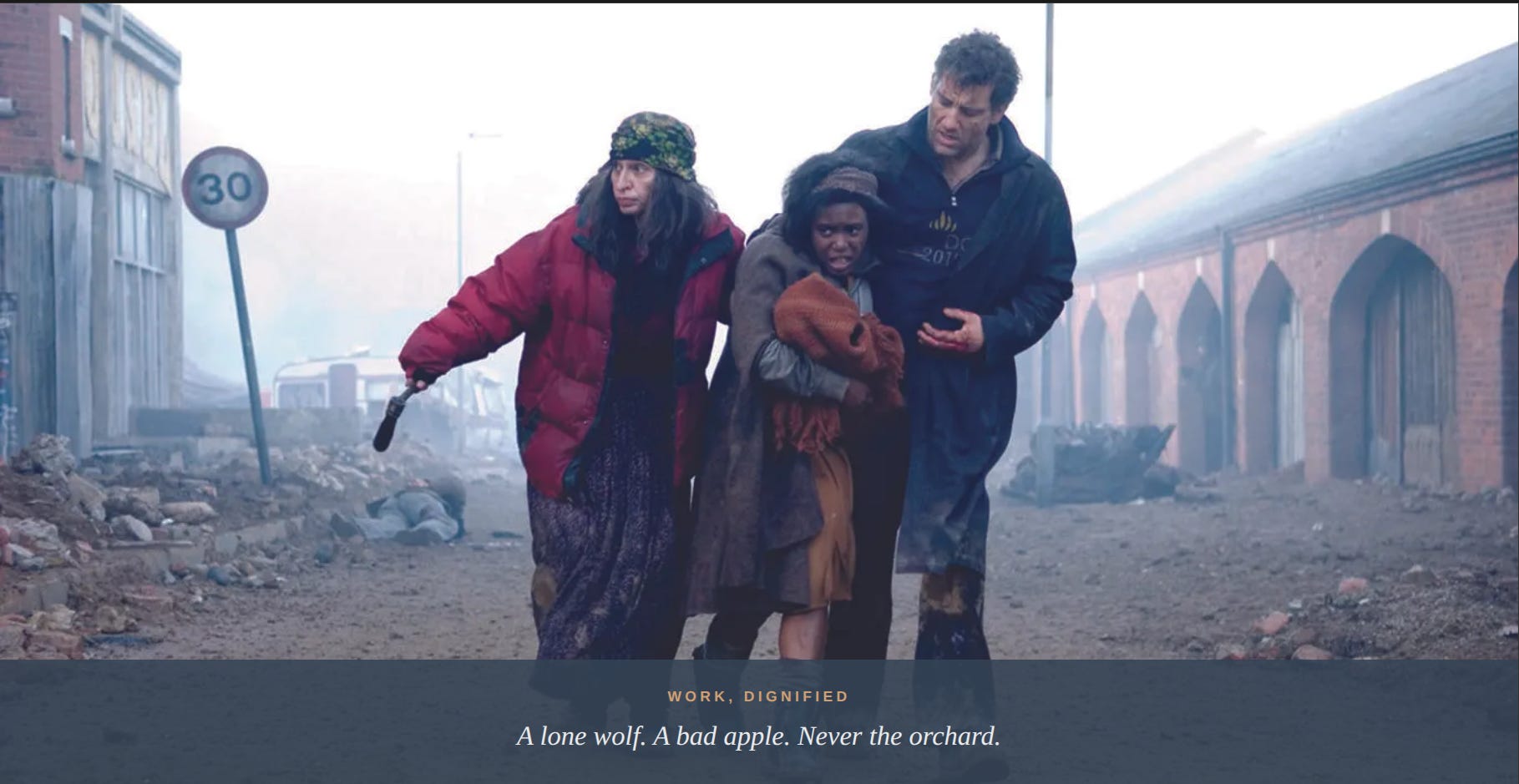
Still from Children of Men (Cuarón, 2006).
The full analysis
I’ve carried a paper in my briefcase for over a decade. The briefcase was a graduation gift from my grandmother, and the paper is a collection of executive summaries from researchers who studied what happened after xenophobic violence swept South Africa in May 2008. Sixty-two people killed. Over 100,000 displaced. Entire communities emptied out in weeks, their shops looted and homes burned behind them.
I kept it because something about it felt unfinished. Not the research; the researchers did their jobs. What felt unfinished was the warning. The findings described a set of conditions and political maneuvers so specific, so mechanistic, that I couldn’t shake the sense I was reading a preview of something that hadn’t happened yet. Not in South Africa. Here.
I was wrong about the timing. It had already been happening here for years. I just didn’t have the language for it yet.
Now I do.
